Swiss commercial register: a practical guide for B2B prospecting
The Swiss commercial register is full of B2B prospects, but searching it by hand on Zefix or cantonal portals quickly hits its limits. Here is how to monitor new companies by NOGA code and canton instead.

Summarize this article with AI
Last updated: November 2026
The Swiss commercial register is the official record of every company registered in the country: sole proprietorships, GmbH/Sàrl, AG/SA, cooperatives and more. For anyone selling to Swiss businesses, it is more than a verification tool. It is a prospect database, updated every working day by the state, free of charge. The catch: it was never designed for prospecting.
Key takeaways
- The Swiss commercial register (Zefix and cantonal portals) is free to search
- 55,654 companies were founded in Switzerland in 2025, a new record
- Zefix has no reliable industry filter and no alerts
- The SOGC publishes 1,200 to 1,500 notices every working day, with no search built for sales use
- Entries are in German, French or Italian depending on the canton
- Combining the NOGA code and the canton turns this public data into a targeted sales pipeline
What the commercial register is and what it is really for
Each canton keeps its own register, but all the data flows into a central federal index: Zefix. In practice, a commercial register entry contains:
- the company name and legal form,
- the UID number (the unique business identifier, in the format CHE-123.456.789),
- the registered office and address,
- the people authorised to sign (board members, managing partners),
- the company purpose, which indirectly tells you the industry.
One point that often surprises foreign companies: there is no English version of the entries. A company registered in Zurich appears in German, one in Geneva in French, one in Lugano in Italian. Zefix itself can be used in English, but the content stays in the canton's official language.
How to search the register: Zefix and the cantonal offices
There are two levels, depending on what you need.

Zefix: the federal central index
Zefix (zefix.ch) is the central index of company names, run by the Federal Commercial Registry Office. It is where to start if you want to look up a company without knowing which canton it is registered in.
You can search by:
- Company name, even partial,
- UID number, the most reliable option if you already have it,
- Registered office, filtered by municipality,
- Name of a person, useful to check a director's mandates.
Basic data (name, office, status, UID) is free. For a certified commercial register extract or official articles of association, you order from the cantonal office for a fee.
Cantonal registers: Geneva and Vaud as examples
The canton of Geneva runs its own portal, which lists more than 58,000 active companies. You can download an ordinary extract as a PDF straight away, which is handy for a quick check, but that document has no legal force. A certified extract is ordered online (fee plus postal delay) or picked up by appointment, for a minimum of CHF 50.
The canton of Vaud works the same way: its portal lets you order an extract or copies of supporting documents (articles of association, deeds of incorporation). Extracts are issued in French; a certified translation into English, German or Italian costs about CHF 100 extra.
The information is public and accessible everywhere. But it is organised for one-off lookups, one company at a time. Not for prospecting at scale.
The limits of manual searching for prospecting
This is where it breaks down. We tested manual searching on Zefix and cantonal portals for several weeks with a typical B2B prospecting scenario, and three obstacles kept coming back.
1. The volume is unmanageable without an industry filter. In 2025, Switzerland set a new record with 55,654 new companies, compared with 52,978 in 2024 (see the month-by-month and canton-by-canton breakdown). The pace continues in 2026: 41,716 new companies between January and September. Nobody can read through that by hand to spot the creations that matter for their business.
2. There is no reliable built-in industry filter. Zefix lets you search by name or office, but not by industry or NOGA code. The company purpose is free text, not a category you can filter on. If you want every new GmbH in construction (NOGA 41-43) founded in Zurich this month, there is no button for that.
3. Updates are daily, but scattered. New entries and changes are published every working day in the SOGC (Swiss Official Gazette of Commerce), at a rate of 1,200 to 1,500 notices a day, in three languages. Following that feed by hand, canton by canton, means watching a giant news feed with no search built for sales.
The result: most sales teams who try to work the commercial register manually either give up after a few weeks or spend a disproportionate amount of time on it for poor results.
Automating new-company monitoring with alerts by NOGA code and canton
The good news: commercial register data is public and structured. It lends itself perfectly to automation, provided you cross it with two key filters.
The NOGA code, your industry filter
NOGA (General Classification of Economic Activities), maintained by the Federal Statistical Office, classifies every company by its main activity, with up to 1,047 codes on five levels, from the section letter (22 broad categories) to the six-digit code. It is the key that turns a raw list of registrations into a targeted list: only consulting firms (code 70), only wholesale (code 46), only construction (codes 41 to 43).
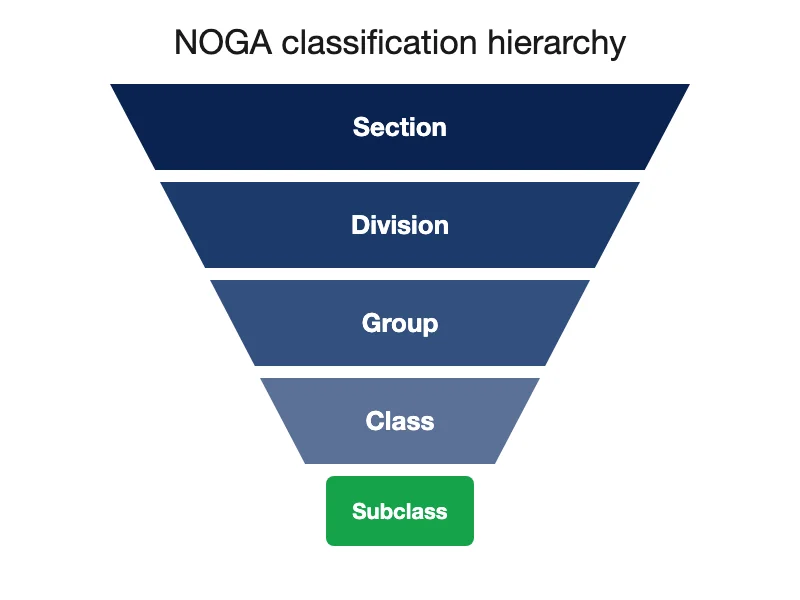
If you don't know the NOGA codes for your target yet, two free tools make it easy: the AI tool to find a NOGA code from a plain description of the activity, and the NOGA 2008-2025 concordance table to find a code from the old classification.
The canton, your geographic filter
Crossing the NOGA code with the canton (or even the municipality) narrows monitoring to your real sales territory: only Zurich and Zug, for example, or only the French-speaking cantons.
How a filtered alert works
In practice, automated monitoring means:
- Setting your criteria: one or more NOGA codes, one or more cantons,
- Getting notified as soon as a matching company is registered,
- Finding the essentials in the alert: company name, legal form, address, directors, without going back to Zefix.
This is exactly what Zenyio does: automated monitoring of the Swiss commercial register, with alerts filtered by NOGA code and canton, built for sales teams who want to spot relevant new companies as soon as they are founded, rather than six months later when a competitor has already contacted them. In my view, that timing is the whole point: a company that has just been founded is still choosing its accountant, insurer, bank and suppliers.

Practical use cases for sales teams
A few scenarios where automated monitoring really makes a difference:
- A business insurance broker targets every new GmbH and AG registered in the canton of Vaud under construction NOGA codes (41-43). They get an alert for each new company and make contact in the first weeks, when liability and business interruption cover is most needed.
- An accounting firm monitors new sole proprietorships and GmbHs in Zurich, across all industries, to offer bookkeeping as soon as the company is registered, while the founder is still looking for a provider.
- A catering equipment supplier filters on NOGA code 56 (food and beverage service) in several cantons to identify every new restaurant or café before it even opens.
- A B2B recruitment agency follows new companies in consulting and business services (NOGA codes 69-70-71), one of the most dynamic sectors, to offer sourcing as soon as a team starts growing.
- A company entering the Swiss market from abroad sets alerts on its target industries across all cantons to build a first list of local prospects without having to read the SOGC in three languages.
In every case, the principle is the same: turn public data that is hard to use at scale into a flow of qualified prospects, delivered straight to your inbox or CRM.
Create my free alert on Zenyio →
Further reading
- Swiss new-company barometer: monthly statistics by canton and industry
- Find a NOGA code with AI: describe an activity, get the matching code
- NOGA 2008-2025 concordance: convert old codes to the new classification
Sources
- Zefix, central business name index, Federal Commercial Registry Office
- Swiss Official Gazette of Commerce (SOGC)
- NOGA classification, Federal Statistical Office
Frequently asked questions
Is the Swiss commercial register free to search?
Yes. Basic information (name, registered office, status, legal form, UID number) is free on Zefix and on the cantonal portals. Only certified extracts and official copies of articles of association are charged.
What is the difference between Zefix and a cantonal commercial register?
Zefix is the federal central index that brings together the data of all cantons. The cantonal register office (Zurich, Geneva, Vaud, Ticino, etc.) is the authority that actually keeps the file and issues certified extracts.
Is the Swiss commercial register available in English?
The Zefix interface is available in English, but entries are published in the official language of the canton where the company is registered: German, French or Italian. Certified English translations of extracts are available from some cantons for an extra fee.
Can you filter the commercial register by industry?
Not on Zefix. A company's industry corresponds to its NOGA code, assigned by the Federal Statistical Office, but no public search lets you combine that code with new registrations. Filtered monitoring tools exist to fill that gap.
How often is the commercial register updated?
Every working day, through the Swiss Official Gazette of Commerce (SOGC), which publishes between 1,200 and 1,500 notices per working day.
How many new companies are founded in Switzerland each year?
55,654 new companies were entered in the commercial register in 2025, a new record, compared with 52,978 in 2024. From January to September 2026, 41,716 new companies were registered, 2.1% more than in the same period of 2025.